
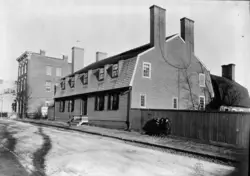
 On August 7, 1783, Frederick Green advertised in the Maryland Gazette, the sale of his mother’s house on Charles Street in Annapolis to settle her estate.
His mother was none other than Anne Catherine Hoof Green- the renowned colonial printer of the very same newspaper– who had passed away in 1775, on the cusp of the American Revolution.
Anne Catherine married printer Jonas Green in 1738, and they moved to Charles Street in Annapolis, where Jonas started a small printing shop. Over the next twenty years, Jonas printed the Maryland Gazette, while also accumulating significant debts.
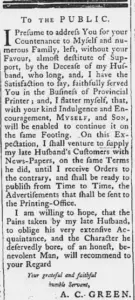 Jonas died in 1767, and Anne Catharine Green took over the print shop’s operations, continued publishing the only newspaper in Annapolis at that time without interruption, while also resolving her late husband’s considerable debt within 3 years of his death. She fulfilled her husband’s contract with the government by publishing the Acts, Votes, and Proceedings of the Maryland Assembly on schedule. Her dependability earned her the same contract the following year, but in her name.
Green- as a single working mother with 6 children— moved the print shop operations from the backyard and into the house itself. This is known from the archaeological investigation that occurred on the property in the 1980s and 90s. Her son William began helping with the family business in January 1768. She resumed solo publication of the Maryland Gazette upon his death in 1770, but soon, her son Frederick stepped in to help publish the Gazette.
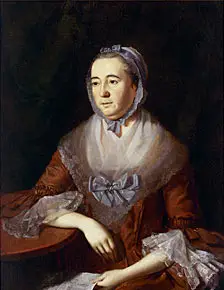
Her competence as a businesswoman also allowed her to buy the building that housed her family and the print shop, which had been leased while Green’s husband ran the business. Her confidence shone in her decision to commission a portrait of herself by one of the foremost colonial painters, Charles Willson Peale. She posed with a paper in her lap that read, “ANNAPOLIS Printer to…” displaying Green’s confidence in a role that broke tradition at the time. In a time when women were expected to play only a domestic role in society, Anne Catharine Hoof Green broke the mold with her success as a printer and businesswoman.
*The Jonas and Anne Catherine Green House is a Private Residence*
To walk in the footsteps of colonial history and learn more about the colonial history that surrounds you, please visit-
The Rising Sun Inn- The Rising Sun Inn, built circa 1753 by Edward Baldwin, is a rare example of a framed 18th century planter’s home and a study in 18th century Maryland vernacular architecture featuring architectural details unique to the Chesapeake Bay area. Now owned by the Ann Arundel Chapter, NSDAR, the Inn was a Red Cross Work Center and a Recreation Center for Ft. Meade soldiers in World War I and II, and a Tea House during the intervening years, welcoming guests from around the world. Today, the Inn continues to serve the community as a museum open to the public, offering historical, cultural, and educational programs.
Linthicum Walks – On the National Register of Historic Places since 1984, Historic Linthicum Walks is a traditional, whitewashed farm house and grounds dating back to the 18th and 19th centuries. It sits in a picturesque park-like setting among a variety of mature trees and gardens with architec
ture representative of the rural Tidewater Maryland style of its time. A farm complex, it originally included a 19th century meat house, a pre-1815 tobacco barn, a family cemetery, and several outbuildings on its 200 acres of farmland. The property is now owned by Anne Arundel County and administered by the Department of Recreation and Parks. It is also an ArbNet Level 1 Arboretum.
Hogshead Trades Museum- This modest wood-frame structure with a gambrel roof is a rare surviving example of a building type that was common in 18th-century Annapolis. It was just this sort of inexpensive rental housing that the new state government pressed into service as barracks for military recruits during the Revolutionary War. Today, visitors learn what life was like for the “lower and middling sort” in early Maryland through an interactive experience with guides dressed in colonial attire and the opportunity to see and handle authentic and reproduction artifacts.
Hammond Harwood House -The Hammond-Harwood House is a museum of early American architecture and art, standing as a testament to the importance of preservation to the residents of Annapolis and America. Built in 1774, this National Historic Landmark presents a window into the lives of the people who built the house, lived in it, and ensured that future generations would enjoy it for years to come. Tours of the House highlight its refined design, unique history, and incomparable collection of paintings by Charles Willson Peale and furniture by John Shaw.
William Paca House– This five-part Georgian mansion was built in the 1760s for William Paca, one of Maryland’s four Signers of the Declaration of Independence and the state’s third Governor. Carefully restored by Historic Annapolis beginning in 1965, today it is recognized as one of the finest Georgian-style homes in the country and a National Historic Landmark. Guided tours of the house, which feature period furnishings and paintings, share the story of William Paca, a young aspiring attorney who became a leader of the Revolutionary movement in the 1770s. Visitors also discover the inner workings of an upper-class household in colonial and revolutionary Annapolis and learn details about the enslaved people who were made to cook, clean, do laundry, and care for the children to provide for the elite lifestyle of the Paca family.
Watermark Tours – Journey into the history, culture, and fun of the Chesapeake region with Annapolis Tours by Watermark. Join a period-attired guide to explore the Annapolis historic district, Maryland State House, United States Naval Academy, and more. Watermark’s tour guides bring history to life for adults, students, and groups of all types.
Charles Carroll House- The seat of the Catholic Carrolls of Annapolis, the Charles Carroll House was the primary urban residence of its most famous owner, Charles Carroll of Carrollton. Today, the property, on the grounds of St. Mary’s Roman Catholic Church, is among the largest and most impressive historic sites in Annapolis. It is owned by the Congregation of the Most Holy Redeemer (Redemptorists), a Roman Catholic congregation of priests and brothers. This historic house and garden was home to three generations of Carrolls and the birthplace of Charles Carroll of Carrollton (1737-1832), the only Catholic signer of the Declaration of Independence. Don’t miss the terraced garden overlooking Spa Creek.
——————————————————–
The Chesapeake Crossroads Heritage Area is a Maryland Certified Heritage Area that celebrates the history, culture, and natural beauty of Annapolis and across Anne Arundel County. A 20-plus year collaboration between Anne Arundel County, the City of Annapolis, and the Maryland Heritage Area Authority, we connect visitors and residents to over 60 incredible destinations, from world-class museums and historic homes to scenic parks, trails, nature preserves, and vibrant arts centers.
Looking for a fun way to get the family out and exploring this summer? We invite you to take part in our 2025 Historic Summer Bucket List Challenge, a fresh take on summer fun that combines learning, adventure, and memory-making. Visit our website ChesapeakeCrossroads.org, to explore a full list of attractions. Get started checking items from the Historic Summer Bucket List!